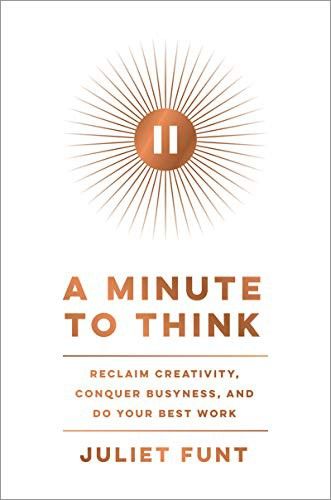
Read with me: A Minute to Think
Juliet Funt on white space - the book I use weekly, underlined to death, on why a pause is where the good work starts.
Just like a good fire needs oxygen and space to grow, so do we. Many of us live our lives where, instead of our ducks being in a row, our squirrels are at a rave. How many times have you heard (or said) “I’m soooooo busy!” 🐿️
What the book is about
Juliet Funt names insatiability, conformity and waste as the three main reasons we end up overworked and “busy”. Then, with refreshing practicality and clarity, she shows how powerful intentional pauses and reflection can be, and how to actually build them in.
The idea at the centre is white space. Through storytelling, humour, research-backed insight and tools you can use the same day, Funt gets you off the productivity treadmill and into a slower, calmer approach to the day. The book helps you reclaim your creativity, step off the busyness and do your best work. 🕐
The best way I can describe what you come away with is her own analogy. It’s the feeling you get in a freshly cleaned house (or room) with no clutter, where you become instinctively aware of the possibilities. Our brains find the same creativity when we give them the same opportunity.
What I took from it
Funt unpacks complex psychological concepts in a way that’s easy to understand, and it’s the kind of book with plenty of “LOL” and “aha” moments. I found it a hugely valuable coaching tool - for myself first, and then with the people I worked alongside - because it’s incredibly easy to pull out one concept or principle at a time and work on it. It’s a guide to intentionally creating new norms in a culture.
👉 This is one of my all-time favourite books. It gets used weekly and it’s a living document for me - heavily underlined, with notes and links to other thinkers (Professor Geert Hofstede, Dee Hock, Tiago Forte, James Clear, David Allen’s Getting Things Done) scribbled through the margins and the gold reflective prompts highlighted.
Should you read it?
Yes. It’s an easy read you can pick up and put down, with plenty of white space of its own and diagrams that bring the principles to life. And it matters - for anyone wanting to reclaim control over their time, it’s a roadmap off the endless cycle of busyness, and a reminder that white space does as much for wellbeing as it does for output.
Where’s the white space in your week right now?
Source: Lisa's reading notes, first shared on radicalhr.nz