Is your week running you?
Why you finish the week exhausted with nothing moved - and the projects-versus-tasks shift that gives you your head back.
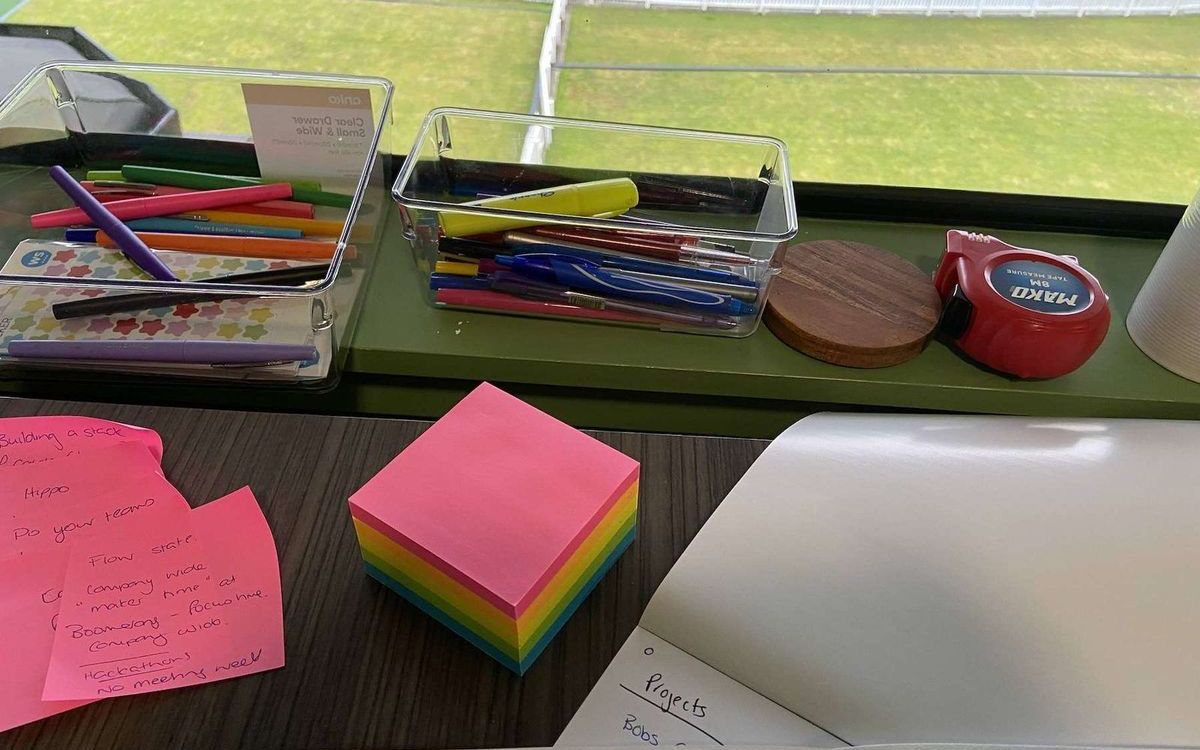
If you’ve ever finished a week, collapsed onto the couch and thought, “How am I this exhausted and still feel like nothing really moved forward?”… you’re not alone.
It’s one of the most common frustrations I hear - from principals, from people running the business side of a farm, from founders. Busy every second of the day, and the needle doesn’t move on the things that really matter.
Here’s the tough truth. The workload is only half of it. The mental load is what’s burning you out.
The weight you can’t see
We carry too much around in our heads. Unfinished tasks, big ideas with nowhere to land, decisions we’re avoiding, conversations we haven’t had yet. It all swirls around, competing for attention and quietly draining energy.
Neuroscientists call that constant juggling cognitive load, and it’s one of the fastest ways to exhaust your prefrontal cortex - the part of your brain that does decision-making, planning and focus. When the load is high, you default to reactive thinking, struggle to prioritise and lose the bandwidth you need for creative and strategic thought.
Sound familiar? Are you nodding along?
The shift - projects versus tasks
The simple (but powerful) principle I teach, the one that consistently helps people take back control, is this. Separate your projects from your tasks.
It comes straight from David Allen’s Getting Things Done, and everything I’ve read in the neuroscience backs it - your brain loves clarity. It craves closed loops. A clear next step and a sense of resolution.
- A project is anything that takes more than one step to complete.
- A task is a single, clear, actionable thing you can do in one go.
This is where most people get stuck… They write “Implement structured literacy” or “Launch a wellbeing programme” on their to-do list and wonder why it never moves. That’s a multi-step project wearing a task’s clothes. It needs its own plan.
Meanwhile, “Email staff the literacy training dates” is a task. You can do it, tick it off, and feel that small, powerful hit of momentum.
Where PARA comes in
Tiago Forte’s PARA method - Projects, Areas, Resources, Archives - takes it a step further, and understanding it was another big milestone in my own journey. One of the biggest drags on productivity is poorly organised commitments and information.
- Projects are short-term efforts with a clear outcome.
- Areas are the ongoing responsibilities you hold - leadership, wellbeing, the curriculum, the accounts.
- Resources are the material and information that support your work.
- Archives are anything finished or inactive.
When you don’t separate projects from areas, everything feels active and urgent. Your brain keeps scanning through unresolved commitments, running a low hum of anxiety and that nagging “I’m missing something” feeling.
Why your brain needs this
Neuroscientist Dr Amy Arnsten describes the brain’s executive function like a battery - it can only hold so many open loops before it starts shutting down. She calls it the brain’s Goldilocks, working best when everything is just right.
Without a system to get things out of your head and organised, you’re asking your brain to do something it’s biologically terrible at - store and prioritise dozens of unresolved items all at once.
The result? You stay stuck in reactive mode. You can’t get at your higher-order thinking (creativity, problem-solving, strategy). And you end the week exhausted but unsatisfied.
Your challenge - two questions
If you really want to make a change, this is where to start.
📅 Block out time with yourself. Not when you “find the time”. Make the time, and treat it like a meeting you wouldn’t cancel on anyone else.
📄 Grab a blank page or whatever digital tool you actually use.
📝 Write down two things.
- What are all the projects I’m carrying right now? (Think beyond work. The personal commitments taking up head space count too.)
- What’s the very next small, actionable step for each one? (This might need its own block - it’s often a harder question than it looks.)
Then pause. Breathe. Notice how writing it down creates space in your head and takes the overwhelm down a notch. That’s neuroscience in action.
This is where real productivity starts
I used to think productivity meant doing more. The most effective people I know do the right things, at the right time, with clarity. They’ve built a system that supports their brain, cuts decision fatigue and makes room for deep, meaningful work. Whether you use David Allen’s system, Tiago Forte’s, or one of your own, the goal is the same - less mental clutter, more momentum.
So, I’d love to know - what’s the very next step you’ll take?
Source: First shared on radicalhr.nz, May 2025